

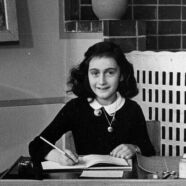
Unknown photographer; Collectie Anne Frank Stichting Amsterdam, Public domain, via Wikimedia Commons
Share This


Print This
Email This
How Cruel and Kind the World Can Be
A fifth-grade required reading assignment taught me how cruel and how kind the world can be in equal measure. Anne Frank: The Diary of a Young Girl haunted me then, and still does some fifty years later. First published in 1947, more than 30 million copies have been sold to date. It has been translated into seventy different languages.
The private thoughts of a teenage girl hiding with her mother, father, sister, and four other Jews in the attic of an Amsterdam office building to evade Hitler’s Gestapo continues to remind the world of the cruel cost of unchecked hatred and intolerance. It also reminds us of the courageous kindness of people like Miep Gies, who worked for Anne’s father, who, along with her husband, Jan Gies, kept the Frankes’ secret and funneled them food and other supplies at the risk of their own safety.
Life in the attic was harsh. No one could talk during the day. No one could move about or use the bathroom until evening. No one was ever allowed outside. Anne, who was only thirteen when she went into hiding, wrote every detail of her confinement in a diary her father had given her. She wrote honestly of her frustrations with her mother and sister. She wrote of her first kiss, shared with Peter van Pels, the only boy in the attic. And she often wrote of the beauty outside the attic window—the blue sky, the birds, a chestnut tree.
Ten-year-old me was mesmerized by Anne’s writings, every page an absolutely surreal accounting of a life that was almost impossible to imagine. As a child, I remember naively believing that the inhumanity that had gripped Anne’s world could never touch mine. I was not a strong reader, but I could not put this book down, and I kept it on a shelf in my room for years after that first reading.
But Anne’s writing taught me something more. It taught me the power of place. Anne wrote of the attic with such clarity that I felt I was there with her in the cramped space at Prinsengracht 263. “I don’t think I shall ever feel really at home in this house but that does not mean that I loathe it here, it is more like being on vacation in a very peculiar boardinghouse. Rather a mad way of looking at being in hiding perhaps but that is how it strikes me,” she wrote. Her hiding place was as much a character in her writing as the other people who shared the attic with the Franks. Simply put, place was what transported me from my cozy world in Nashville, Tennessee, to a hiding place where the threat of being found, arrested, and shipped off in a train car to a death camp was present every day.
This past February, I traveled to Amsterdam, making my first pilgrimage to the Anne Frank House. It was strange climbing the stairs into the attic just as Anne had on July 6, 1942. It was particularly strange being there at a time, some eighty years later, when the world seemed to be forgetting the human consequences of Hitler’s National Socialistic vision that led to the deaths of roughly six million Jews.
Truth be told, walking through the attic was also disappointing. The rooms, at Otto Frank’s insistence, were mostly bare—a stark reminder of the Nazi’s looting after the family’s arrest. I respected that decision, but I had imagined the space as Anne had described it—a small table, a few chairs, a cupboard, beds. Movie posters still hang on the walls in Anne’s room, images that had given her a little sense of normalcy, and there are re-creations of other spaces in other parts of the museum. But a part of me, a small part, wished I hadn’t gone, that I had kept the image of the attic that Anne had painted so clearly protected in my thoughts.
I exited the house through the museum shop as everyone must. I bought a couple of postcards and a journal, a reproduction of Anne’s diary. I’m not really sure why I bought it. I don’t keep a diary. But I think it serves as a reminder of the power of words placed on an empty page. The power of a writer to transport us to a foreign world and make us a part of it. The power of a writer to remind us to be kind to one another, because at the end of the day, we share a single humanity.