

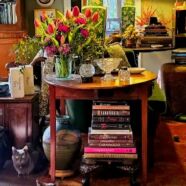


On Hounded Ground, A Holiness Into The Wor(l)d: Home and the Creative Life
To live content with small means, to seek elegance rather than luxury, and refinement rather than fashion, to be worthy, not respectable, and wealthy, not rich, to study hard, think quietly, talk gently, act frankly, to listen to stars and birds, to babes and sages, with open heart, to bear all cheerfully, do all bravely, await occasions, hurry never, in a word to let the spiritual, unbidden and unconscious, grow up through the common, this is to be my symphony.
—William Henry Channing
The poetic place-names of my hometown, Kannapolis, North Carolina, and my address, Upper Enochville Road, caught my attention quite early. Biblical geography and Greek image. “Kannapolis” derives from the combination of the founding Cannon textile family name, and the Greek words kanna=reeds and polis=city—thusly “City of Looms.” Enoch is one of the Antediluvian Patriarchs, father of Methuselah.
Home. A five-room early 1940s bungalow—the small back porch and small bath added a little later, before my parents bought it at the end of that decade. A small living room, ten-by-twelve, its four walls violated by three doors: one into a bedroom, another into a bedroom-sitting room, the third onto the front porch of the house. A bare bulb with a pull-string lights the room, except when the fancy satin-shaded “Victorian” lamp, inherited from my maternal grandparents, is on. Usually the room is “closed up,” off limits to all but the preacher and the insurance agent, and the celebrations of Christmas.
A half basement, open to the crawl space, houses the washing machine and the central coal furnace and coal bin. To this basement I retreated as a fifteen-year-old, after the central heating was installed, eager for privacy in a house with none.
We surround ourselves with what we both love and can afford. No matter what our condition in life, it is this manifestation of self-perception, family, community, need, desire, and hope that invents and stabilizes our surroundings.
This was a time, the 1950s, when play took place outdoors, and the outdoors provided the imagination with endless un-televised, un-computerized, hours of entertainment. Almost every yard on the street was hallowed by such hounded ground, and described their owners as White Trash, more or less, but named them each, too, as part of a neighborhood where a kind of nobility would gather under the trees and, with the cardinals, tree frogs, cicadas, and crickets, watch, almost nightly in good weather, the sun go down, and the stars, one by one, blacken with shadows the swept and raked dust. Then, eventually, even the children would enter the warm spare houses of beaded board and linoleum, of Sears furnishings, The Bible, and Life and Look magazines—of red-eye gravy, grits, pinto beans, bacon, fried chicken, and corn bread. Every day except Sunday, at five a.m., Cannon Mill’s wake-up horn would blow.
I can laugh at and forgive the child who thought that people who had yards with pine trees scattering pinecones in their yards were inaccessibly rich. Those houses that I knew of, on the other side of town, had lawns (not yards) of pine trees and azaleas instead of silver maples, chinaberry trees, cedars, and dying elms. And even sometimes paved driveways and brick sidewalks to the front door.
Not without some trepidation did my partner, Stanley, and I, in 1981, both twenty-eight at the time, begin saving for and designing a house. Two minds full of sentimental memories and impressions representative of places and faces of the past, one of eastern North Carolina (Scotch and English, Presbyterian, humble, clear-thinking), the other, mine, of the textile piedmont with mountain roots (Methodist, fiery irrational Scotch-Irish, and industrious Pennsylvania-Dutch with some Cherokee stirred in for fine measure). Fantasies, too, of the always wanted and never had. How to bring all to fruition with style, class, unpretentiousness, and a meager budget?
People are all the same and just find new ways of playing at who they are. We built our house. Unlike the house of my youth, it is not too small for comfort, only too small for more than two people to live in. We found the basic plan, the Volkswagen House, in a book, entitled 30 Energy Efficient Houses, in the House Undergraduate Library at Carolina. Supposedly, in the late 1970s, one could build it with used materials for $20,000. Stanley’s brother-in-law, a Farm Bureau agent, found someone in eastern North Carolina who had built it. Stanley, having studied architecture as an undergraduate at North Carolina State, tweaked the plan a little to make it a little more gracious, and a tiny bit bigger. With a builder from Burlington, North Carolina, we had it built for $42,000. Five friends helped us lay the Herringbone-patterned brick paver floor. Its partly passive solar 1600 square feet (we have expanded in small ways five times in forty-plus years) and traditional cypress exterior stained gray, and its cottage-sized rooms, mask the spaciousness of its central interior open plan.
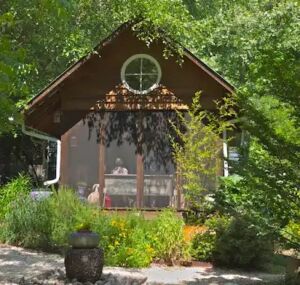
Frog Level Exterior
We named our new homeplace Golgonooza at Frog Level. Our little community, on the edge of the Orange Grove community, twelve miles northwest of Chapel Hill, and seven miles southwest of Hillsborough, has been called Frog Level for at least a hundred years. Like numerous places across the South, it is noted for its “low places in the road” home to frogs, toads, copperheads, black snakes, crows, pileated woodpeckers, owls, mourning doves, cardinals, terrapins, possums, raccoons, fox, squirrels, and innumerable voluble tree frogs and peepers. And not long before our arrival quail, bobwhites, and bobcats. Golgonooza, from the Romantic poet William Blake’s mythology, is the great city of Imagination where all the opposites are recognized as One: religion and science, art and industry, male and female, Life and Death, earthly and heavenly, and so on.
The surrounding horse, dairy, and organic farms, the woods, the native plant garden, the screen porch, the Japonaiserie garden, and the deck expand and enfold simultaneously. A visitor finds on these four-point-two acres and within these two floors and art covered walls a classicism born of local primitive traditions; an appreciation of eighteenth, nineteenth, and Modernist twentieth-century aesthetics; an inborn sense of balance; a beauty originating from economy; and a fascination with color, shape, and texture. We paid off our loan in fifteen years. The house, our home, was ours. When I retired in 2011 from thirty-five years of working as a librarian at UNC-Chapel Hill, we began turning my studio space, once again, into an Arabesque caprice which includes an altar—adorned with the spiritual symbols and natural objects that inspire me.
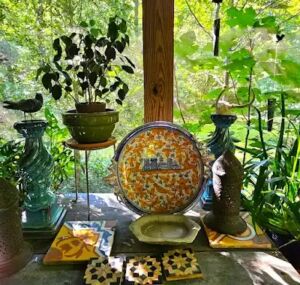
From the Frog Level Porch
Here we live inside and outside as one. The interior is a garden of the mind. I know too many houses that show nothing of their owners. A home should reveal clues to the inner being of its owner(s). In its rooms something of childhood should linger and something of the future portend. A home tells the moving toward of the person or persons living in it. Home intersects past and future, where the present becomes both what has been and what is desired and will be. Outside, now, as I write, a pileated woodpecker’s crazy call vibrates through the window screens. A bluebird flies from cypress to rooftop to pergola. Morning is broken, always, by our neighborhood “murder of crows.” A toad that lives under the roots of the moss garden in a pot, basks in the sunlight on the rocks. A black racer moves quickly across the moss yard, spotted with, yes, pinecones, while the resident hawk screeches at the squirrels and vibrates in the daytime sonorous dreams of the woodland owls. In addition to the nighttime oratorio of owls, scarily in the last couple of years, a shiver of coyotes races and scars the darkness.
I recall Lord DeWitt Dogmeat Chocolate Thunder, the Labrador, now gone over twenty years, feet in air, asleep on the worn leather sofa. His first sisters, kittles Natty Kathmandu Dreads and Katie Kali Micky, also gone. The meteor dawg, poor previously abused Giusticio (Justice), also in his resting place in the yard. The “new” cats, who sistered both dogs, Lucy Tattoo Mae and Willie Mixie Mae, have also entered the pet cemetery marked with a recycled obelisk tombstone carved with the words “God Dog.” Both nursed Lord DeWitt so sweetly sleeping on each side of him, washing his face daily as he aged into his venerable nineteenth year—stricken with permanent vertigo, and so ancient he had to walk between our legs to visit the yard. They washed him too as he drifted away to Dog Elysium the day the vet came to put him down. Five years gone, there too in the cemetery at woods edge, burned to ash and dust, Bijan di Lon di Swan, our seventy-pound Aussie Cattle / Lab mix lapdog, their last brother, who slept with his head tucked like a swan. Will these be our last pets? Likely not, for a house is not a home unless there are fur-people in it.
Indeed, our third pair of cat-sisters, Virginia Sitwell Toklas and Vita Stevie Stein, who nursed Bijan in his last years, sleep next to the fireplace in the Cwtch. We learned the term Cwtch, a key element in Welsh cultural identity, for a comforting, safe, internal and external living space, on our first trip to Wales where I met with the Welsh painter Clive Hicks-Jenkins when collaborating with him on a book. Having just expanded a room into a “sitting room” we and our friends endlessly discussed what to call the room. A dear friend, on the trip with us, suggested this term. How could we not choose it! Hanging above the door is a slate tile, from Wales, inscribed with the term, and below it a ball-shaped Christmas ornament decorated with an eye . . . an ancient talisman to ward off the Evil Eye. Another, in the shape of an eye, suspends from the ceiling fan pull inside the room.
Forty-three years after moving in, the painted stairs have taken on the patina of wear for which I had yearned. Our marriage, legalized in 2014 among a small group of friends and sanctified at the Chapel of the Cross in 2015 with 150 in attendance, now at forty-five, shows a patina too, glowing with a chosen family from all walks of life, as well as the families into which we were born. Our parents are gone, as are some of our siblings, and even a number of our friends, including elder gay mentors, made during our almost fifty years in Orange County, North Carolina. The early days of the AIDS epidemic took quite a few friends and acquaintances. COVID took others here at home and across the globe. As Early Acceptance members of Carol Woods Retirement Community, we will be moving in just a few months and are already downsizing our collections. We, and our friends, are mourning the loss of Golgonooza at Frog Level already. We keep reminding ourselves, and them, of the philosophy and principles I have conveyed in this essay. We will make another home, certainly smaller and thus insistently different, but nevertheless a home in which Channing’s philosophy abides and finds a new manifestation, a new beauty, a new charm, a new simplicity, and authenticity.
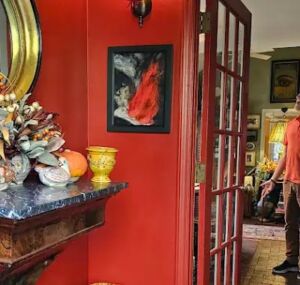
Frog Level Red
The French philosopher, Gaston Bachelard, in The Poetics of Space observes, “If we look at it intimately, the humblest dwelling has beauty. Authors of books on ‘the humble home’ often mention this feature. Finding little to describe . . . they spend little time there, so they describe it as it actually is, without really experiencing its primitiveness, a primitiveness which belongs to all, rich and poor alike, if they are willing to dream.”
This primitiveness, this unity of human values, is what I seek in my writing, and in my relationships—my husband; my family; my friends; my collaborators in literature, music, and visual art; my readers; my former coworkers. For most of all of these I could easily substitute “our,” for without Stanley and the cats, home remains meaningless.
Home is where solitude affords me shelter to write, true repose where the “plainest facts” make themselves into poems. Is this not what home is? A poem written by a community of like-minded beings in their shared solitude? I say, “A Holiness into the wo(r)ld. Enter into its courts with praise.”
The bed lies unmade and the breakfast dishes, unwashed. On top of the dresser a collection of North Carolina pottery vases stands, a parliament of owls, wise, functional, and beautiful, like this house. A painted screen reminds me of a best friend, now dead from AIDS over forty years, who could turn a bashed-in frame into a work of art. So many friends are now on to another reincarnation. How and where and when will our energies meet again?
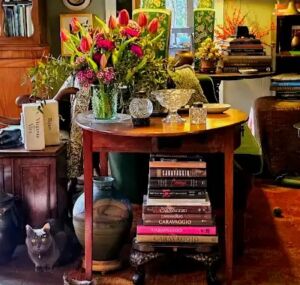
Frog Level Books
This Journey
This a good place
You have come without anything
but the smell
on your hands
of your suitcase from a previous journey
Perhaps a word or two
spoken in
another language
perhaps
one songbird’s tender
mercy under a summer sun
It is a good place surely
for you are
here
without malice
and if as you think
it must be true:
there is a reason for being here
whatever it might be
however
it insinuates itself into you
Abridged and adapted from A Holiness into the Wor(l)d: Home and the Creative Life in a limited-edition portfolio book of the Beam and Finch home by Elizabeth Matheson, Golgnoooza at Frog Level, 2026.
*All photographs by Elizabeth Matheson.
What wonderful writing and story! We feel so fortunate to have shared even a small part of your journey through this life. Love and peace to both of you as you travel forward through time’s bore.
Stan and Sue
Loveliest portrait of a home and the meaning of home, enhanced by Elizabeth’s photographs, that I have ever read.
Jay