



The Mystery of Great-Grandfather: William H. Brooks
Sometimes an ancestor’s photograph raises questions that demand answers. How to parse those answers, in light of the society of his day, is a challenge to his descendants. And are those questions still relevant to the successful life his great-granddaughter has made for herself?
The Halethorpe Colored School (1924–1948)
In October 2025, I attended the 100th anniversary of the Halethorpe Colored School, constructed in 1924 in my hometown, Halethorpe, Maryland, located about seven miles from the Baltimore city line. The structure and property have been the Halethorpe Civic Center since 1958 and was updated to fit the needs of the community.
The Civic Center is across the road from my family home where I spent my formative years. It is a Sears Roebuck and Company Craft House obtained primarily through mail order and assembled on site. Ours was built in the 1920s. It was owned by my maternal great-grandfather, William H. Brooks (1858–1932). It occupies a triangular shape of land of approximately an acre.
The two-day celebration of the Halethorpe Colored School Centennial brought back many memories and provided useful information about how the school and the community developed. It was a reminder of my roots and my good fortune, a sentimental yet sobering experience. I had left my hometown of Halethorpe when I went to college, returning briefly to visit relatives. As a former Peace Corps volunteer and retired foreign service officer, I have lived overseas for more than twenty-five years, with short visits home between overseas and Washington assignments. At the two-day event, I saw a few people I had grown up with, and fewer of my mother’s age. I met children of friends of mine, former neighbors, and the son of an old boyfriend. It was a delightful event.
I had gathered pictures, mainly for a memoir I had written in 2008 about my aunt, titled “Miss Myrtle.” Myrtle Brooks, my mother’s sister, was the director of the Halethorpe Civic Center for more than thirty years. The pictures and a copy of my memoir are now in the Civic Center archives.
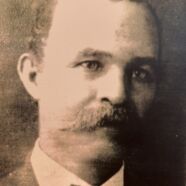
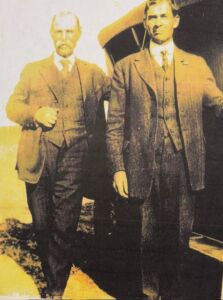
There are some photos in my family, however, that do not quite fit this family narrative without question marks. One such is a photo of my great-grandfather William H. Brooks, a blue-eyed gentleman with a fair moustache. And another of him with his brother Douglas with his longish floppy hair, to all appearances two Caucasian men. But as a young woman busy with her own life, I did not spend the time to delve into these intriguing questions.
The Brooks Brothers
Homecoming
The last time I had spent significant time in my hometown was when Aunt Myrtle died in 1992, just two months after my father, Charles Brown, had died in Elkridge.
Returning to the area in October 2025 was an emotional experience, reminding me of how lucky I have been to have many opportunities and privileges, and most of all, an abundance of love. My family was not rich yet not poor. We lived in a nurturing community. Everybody knew each other and looked out for each other. It was a well-kept neighborhood and is even more so now.
From the former school grounds, I could see my family home across the road, the house built by my great-grandfather, William H. Brooks, which my mother later acquired. On that October day, I was overcome with nostalgia—remembering family, neighbors, playmates, and our three dogs, who were allowed to roam freely during the day: Sheba, the cocker spaniel; Duke, the boxer; and Brownie, the Irish setter. The three dogs loved to set off from the Sycamore tree and race down to the edge of the property, plunging into the mulberry bush to sniff it out. Of course, the female, Sheba, the smallest, was the leader of the pack. It occurred to me that most likely our dogs never saw a leash in their lives. I also recalled the long driveway where I used to practice driving before I was old enough to get on the road or obtain a driver’s license. Since I could not turn around at the bottom of the driveway, I became equally skilled in driving forward and putting the car in reverse to back up the long driveway.
The Halethorpe Colored School closed in 1943, at which time the Black children in Halethorpe and vicinity took the bus for seven miles to Benjamin Banneker Elementary, Junior, and Senior School in Catonsville, Maryland, where I later attended school through the tenth grade. The year after the enactment of the school desegregation law, Brown v. Board of Education in 1954, in the fall of 1955, I was one of the first nine Black students who made the choice to integrate the previously all-white school, Catonsville High School, located in the stately area of Rolling Road. The white population was about twelve hundred students. I chose to change schools not because Banneker was inadequate, but because I wanted to exercise my right to do so. A few years ago, one of my fellow Black students reminded me of the jeering crowd of parents and others present as we disembarked the bus. I had completely blocked that out of my mind.
One day when I had driven my mother’s 1957 Chevy Impala to school, a white boy, who often harassed the Black girls, shouted, referring to the stylish convertible, “I bet she lives in a tin shack.” I pondered my response. I did not want to escalate the situation or compromise my dignity. So, I said, “Follow me home and you’ll see that I don’t.” It is unfortunate how some make assumptions about “the other” based on race, linking it to social class, intellect, and morality. As I look at my family home, I still remember the boy’s cruel remarks. My point was simple: There was no tin shack. While it was not grand, there were three bedrooms and one bath upstairs. Downstairs there was living room, dining room, eat-in kitchen, and a large screened-in porch. The house was comparable to many of those in the nearby middle-class white suburbs of Halethorpe.
The Main Character, Great-Grandfather William H. Brooks (1858–1932)
The main reason for this account is to talk about my maternal great-grandfather, William H. Brooks. Note that he was born in 1858, four years before the Emancipation Proclamation freed the slaves.
William was a key player in developing an area of East Halethorpe community on North East Avenue and side roads such as Spencer and Washington Streets, and in acquiring the Colored School. He and his fellow members of a group known as the Businessmen’s League made it their mission to build houses and promote home ownership for African Americans in Halethorpe. In addition, the League and other community members donated $1,897 and land to build the colored school and successfully petition Baltimore County to provide additional funding and hire teachers.
Each member of the League brought their own expertise. In plastering and masonry work, William provided material from the business he owned, the Anne Arundel Sand and Gravel Company. I now realize why my father, some of my mother’s brothers, and a brother-in-law worked at Arundel Sand. I only learned recently that it had formerly been owned by my great-granddaddy.
The League also received backing from the legendary Jewish philanthropist Julius Rosenwald, who promoted the establishment of colored schools and home ownership among Black communities throughout the South. Rosenwald was also the president of Sears Roebuck and Company. In partnership with Booker T. Washington, he funded over 5,000 schools across the segregated South.
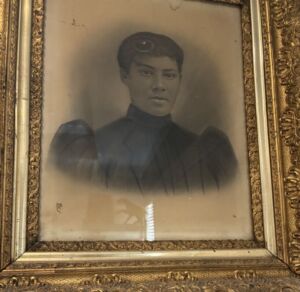
Great-grandfather William H. Brooks died in 1932. He left an impressive legacy, especially for that era. His legacy is indisputable, but what was his heritage? It is sometimes difficult to decipher facts from folklore. In the 1910 US Census, he is listed as mulatto, occupation: pumpman. In the 1920 census, he is listed as Black, occupation: farmer. In my mother’s oral history interview with a faculty member of the University of North Carolina, Chapel Hill, she reported that her grandfather told her that he was white but could not declare that because he married a colored woman, Elizabeth Gaither Brooks. In pictures of William, his brother Douglas, and their father (my great-great-grandfather) they all look Caucasian. In a more perfect world, race should not be such a defining factor.
Elizabeth Brooks
Sadly, his wife, Elizabeth, died giving birth to Carl, the youngest of their seven children.
William went on to marry a woman named Isabella, known as Miss Bell, who raised his children. After her death, he married Daisy Weaver, whom I knew as Mama Daisy when my parents and I, as a young child, lived in the house on Northeast Avenue. Daisy’s beauty and soft-spoken voice belied her will of steel, her strict, stern disciplinarian ways, and her no-nonsense manner.
Daisy died in 1945. Years later, when my stepbrother, Paul Johnson, and I were in our early teens, we discovered a musty storage room in the cellar under the house. Alongside jars of preserved fruit and jam were bottles of dandelion wine Mama Daisy had made years earlier. We decided to sample the wine, but Paul did more than sample it. In fact, we both gulped it down, not realizing that wine was meant to be sipped. I shudder to think what Daisy would have done had she still been alive to witness our experiment. It would not have been pretty.
Back to William and his business partners. They built several houses in the East Halethorpe community on North East Avenue and side roads such as Spencer and Washington. William built the first four homes on North East Avenue, including the one where he and his family resided. Moreover, William and other family members acquired additional properties in rural Maryland and one in Baltimore.
A few years ago, I found a copy of William’s 1930 will and testament written two years before his death. It lists the properties, homes, and nest eggs he left to six of his seven children. He was also generous to his wife, Daisy, leaving her the family home as well as other assets.
I wish I knew more about the man himself and his personality. I know of his various properties, which included a total of fourteen houses, including one in Baltimore that had once been occupied by the great Civil Rights advocate and first African American Supreme Court justice, Thurgood Marshall. William also owned various land lots and the business, Arundel Sand and Gravel Company.
Before William died, he started our small family cemetery known as Saints’ Rest, a peaceful area in Anne Arundel County where he and many relatives are buried. It is still in use.
He and his brother Douglas and others owned vacant property that is now the site of the Baltimore/Washington Airport (BWI). My mother reported years after William died that the State of Maryland purchased the property from William’s brothers for $3,000. I believe it was an eminent domain case.
William was very handsome and dignified looking. I have pictures of him and my beautiful great-grandmother and his parents, my great-great-grandparents, but I don’t know William the man himself. He was clearly generous to his family. My mother, who idolized him, lived with her grandfather instead of staying in Elkridge with her parents and seven siblings.

William Brooks
William was obviously very industrious and forward thinking, an astute businessman. However, what was he like at the dinner table? Was he a patient man? Was he a churchgoer, or more like his son Herman, my grandfather? Was he funny? Was he gruff? Was he bossy? What kind of a sense of humor did he have or did he have one? What kind of art did he like, what kind of music? Did he drink? Did he appreciate Daisy’s dandelion wine?
He is very impressive when you read and hear about him and that makes me wish I had probed more deeply about him and my other ancestors on both sides, asked more questions, taken notes, and listened more attentively.
That said, I am grateful that I know as much as I do about this man who appeared to have been larger than life. My situation seemed so natural to me that I took it for granted. I never thought I would forget so much I had been told in my youth and onward. Now I long to know more.
As I have gotten older, I realize maturity has made me develop a special bond to the past and I have become more curious about those who came before me. Alas those storytellers are now gone, but fortunately not completely forgotten.
Fascinating history, Brenda! I’m ready to believe that your great grandfather was White, listing himself as Black so he could marry and live with the woman he loved. I have another friend whose grandfather did the same thing. Your story is a testament to how absolutely irrelevant the race lines are except in people’s minds which they too often make into laws. I was fascinated to read that you forgot the white parents jeering at you and your friends when you got off the bus to attend the newly integrated white school. Sometimes forgetting is a way of letting rudeness slide off like water off a duck’s back. Your total joy at life and friendship regardless of race has been an inspiration to me always. I feel this great grandfather’s character truly came through in his deeds. I know you don’t know what he was like at the dinner table, but from the photos and the history you’ve shared with us all, I believe I can see him winking.
Dear Karen,
Thank you for kind, thoughtful comments. I value your opinion and friendship.
Affectionately, Brenda
Wonderful and thought provoking piece Brenda. It made me think about what I say after leaving the theater, “I sure am glad I saw this show, I feel sorry for those who won’t ever see it.” Your great-father was a kind, astute and giving gentleman. Your hometown community was so fortunate he was part of it.
Bart,
Thank you for your thoughtful comments.I am honored that Samia promoted me or write about my great grandfather. It was a gratifying experience.